Journal of Neuroscience and Mental Health is a peer-reviewed academic journal focusing on neurology, psychiatry and mental health, with both domestic and international distribution. Since 2006, it has been included by the Institute of Source Journals for Chinese Scientific and Technical Papers and Citations.
The journal is dedicated to upholding rigorous publication standards and fostering scholarly exchange. In line with national health policies and the developmental principles of the disciplines it serves, it aims to enhance research quality and maximize societal impact. This journal promptly disseminates major scientific advances and facilitates academic communication both within China and internationally. It features cutting-edge teaching achievements, research findings and clinical diagnosis and treatment experience across relevant disciplines. Regular columns include Forum, Editorial, Original Research, Academic Exchange, Case Report, Review, Teaching Research, Nursing Research, etc.
1 Submission Method and Requirements
1.1 Online Submission: The journal does not accept hard-copy submissions. Please submit manuscripts via the online manuscript management system at https://www.jnmh.cn. Upon successful online submission, authors are required to pay the manuscript handling fee as instructed and submit the following materials by mail: (1) Submission Letter & Copyright Transfer Agreement: Download and complete the Journal of Neuroscience and Mental Health Manuscript Submission Letter and the Copyright Transfer Agreement for Journals journals sponsored or co-sponsored by the Chinese Medical Doctor Association from the website’s homepage. These documents must be endorsed (with an official seal) by the author’s institution. For manuscripts involving confidential content, approval documentation from the relevant department is required. (2) If the research was supported by a funding grant,a copy of the funding approval document should be included.
1.2 Manuscripts should exhibit scientific rigor, authenticity, and practical value. They should be clearly focused, concisely written, logically structured, and based on reliable data. Original research articles are typically limited to 8000 words, including tables, figures, abstracts and references. Word limits for other types of submissions may vary.
1.3 Medical Ethics & Informed Consent: Studies must adhere to fundamental medical ethics principles. For research involving human subjects, authors should confirm that the procedures were conducted in accordancen with the ethical standards of the relevant institutional, regional, or national ethics review committee. A copy of the ethics approval document, including the approval number (which should also be cited in the manuscript), and evidence of informed consent from participants or their legal guardians must be provided. For animal studies, authors must indicate compliance with institutional and national guidelines for the care and use of laboratory animals. If applicable, documentation of approval from the experimental animal ethics committee, including the approval number, should also be submitted.
1.4 Conflicts of Interest: Upon submission, authors must provide a conflict of interest disclosure statement detailing all financial or non-financial relationships. Authors are solely responsible for the accuracy of this disclosure. The corresponding author is responsible for signing the form. If all authors declare no actual or potential conflicts, the following statement should be included: "All authors declare that there are no conflicts of interest related to this article."
1.5 Author Contributions: All manuscripts must include an Author Contributions statement specifying the role of each author in the study’s conception, design, conduct and reporting. Contributions may pertain to, but are not limited to: conceptualization, study preparation, data analysis, data interpretation, manuscript writing, manuscript revision, data collection, data curation, providing cases, providing analytical tools, funding acquisition, literature search/review, model construction, or figure creation. Describe contributions should be described based on actual involvement, for example: Study design: Wang XX, Zhao XX; Manuscript writing: Li XX; Manuscript revision: Zhang XX.
1.6 Fund programs: Projects supported by national, ministerial, provincial, or other key projects should be indicated. Funding information must be provided in both Chinese and English and placed below the respective keywords. Format example:
Fund programs: National Natural Science Foundation of China (81701125); Shandong Key R&D Program (2017GSF18129)
1.7 Maps: Manuscripts containing maps must comply with China’s Regulations on the Management of Maps. A national map review system is in effect. Any map intended for public distribution must be submitted for review to the competent administrative authority for surveying, mapping, and geoinformation, with the exception of simplified maps such as tourist maps, street maps, or subway route maps.
2 Submission of Manuscripts
2.1 Title
Titles should be concise, informative and reflect the core content of the manuscript. Chinese titles should not exceed 25 Chinese characters, preferably without subtitles or punctuation, and avoid abbreviations where possible. The English title must correspond semantically to the Chinese title.
2.2 Author Affiliation and Signature
All author names should be listed in order below the title in the order determined by mutual agreement prior to submission. Once submitted, the authorship order may not be altered without valid reason and editorial approval.
Affiliation (including the specific department) and postal code are listed below the author names, with the corresponding author’s Email address clearly indicated. All information must be provided in both Chinese and English.
Authors must meet all four of the following criteria:
(1) Contributions to the conception, or design of the study, or the analysis and interpretation of data;
(2) Drafting the manuscript or revising it critically for important intellectual content;
(3) Final approval of the version should be published;
(4) Agreement to be accountable for all aspects of the work and ensure that any issues related to the accuracy and integrity of the research are properly investigated and resolved.
Individuals who only participated in funding acquisition, data collection, or general administrators support are not eligible for authorship.
2.3 Abstract
All manuscripts (except Case Reports) must include both Chinese and English abstracts. Original Research manuscripts should feature structured abstracts including four sections: Objective, Methods, Results, Conclusions. Review manuscripts may use indicative abstracts.
Abstracts should be written in the third person, without figures, tables, references, comments or interpretations.
English abstracts should include the title, author names (in Pinyin), official institutional translation, city, postal code and country. All authors and their respective affiliations should be listed in full.
Both Chinese and English abstracts should be approximately 400 words in length. While the content of both versions should be consistent, the English abstract may be slightly more detailed for international academic exchange.
2.4 Key Words
Key words (3 to 8) are preferably selected from the latest version of the Medical Subject Headings (MeSH) compiled by the National Library of Medicine (USA). Chinese translations may refer to the Annotated Alphabetical List of Medical Subject Headings compiled by the Institute of Medical Information, Chinese Academy of Medical Sciences.
Unlisted or newly emerging terms (free terms) may be used as key words and should preferably appear at the end of the key words list. Key words related to traditional Chinese medicine (TCM) should be selected from the Chinese Materia Medica Subject Headings compiled by the Institute of TCM Information, China Academy of Chinese Medical Sciences.
Manuscripts with English abstracts must include corresponding English key words. Abbreviations in key words should be be written out in full in accordance with the Annotated Alphabetical List of Medical Subject Headings. The first letter of the first word in each English key word is capitalized, and key words are separated by semicolons.
2.5 Medical Nomenclature
Standardized medical terms published by the National Committee for Terminology in Sciences and Technologies are mandatory. For terms not yet formally reviewed or standardized, authors may refer to the latest editions of the latest MeSH, the Annotated Alphabetical List of Medical Subject Headings or Chinese Materia Medica Subject Headings.
Infrequently translated terms should be accompanied by their original-language equivalents at first mention in the manuscript.
Names of Chinese and Western medicines must confirm to the latest Pharmacopoeia of the People’s Republic of China and Chinese Approved Drug Names (compiled by the Chinese Pharmacopoeia Commission). Brand names may only be used after the generic name is indicated.
For TCM herbs, official names should be used; those not included in the Pharmacopoeia must be accompanied by their Latin names.
Abbreviations are used sparingly. The full Chinese name and the corresponding English full name (followed by the abbreviation in parentheses) must be provided upon first appearance.
2.6 Language Usage
Manuscripts must adhere to the Law of the People’s Republic of China on the Standard Spoken and Written Chinese Language (2000-10-31), the Notice on Further Standardizing the Use of Characters in Publications (issued by the National Press and Publication Administration on 2010-12-23) and the Regulations on the Use of Chinese Characters in Publications (issued by the National Press and Publication Administration and the State Language Commission in 1992), with reference to the Table of General Standard Chinese Characters (issued by the Ministry of Education and the State Language Commission in June 2013).
2.7 Clinical Trial Registration Number
The clinical trial registration number must be a globally unique number obtained from a primary clinical trial registry recognized by the World Health Organization (WHO).
The number should be listed below the funding section, with the heading Trial registration (in the same font and size as other subheadings in the abstract), including the registry name and registration number.
2.8 Statistical Methods
2.8.1 Statistical Symbols: Comply with GB/T 3358.1-2009 Statistical Terms and Symbols; all statistical symbols are in italics.
2.8.2 Data Expression and Description:
Normally distributed quantitative data: Mean ± Standard Deviation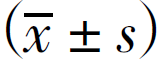
Non-normally distributed quantitative data: Median (25th percentile, 75th percentile) [ ]
]
Statistical tables: Rational arrangement of row and column headings with clear data definitions; three-line tables (top, header, bottom lines) are required, with an additional dividing line above the total row or statistical results (e.g., t-value, P-value). Rows and columns must not be inverted, and data in the same column must use the same unit with consistent significant figures (generally determined by 1/3 of the standard deviation).
Statistical figures: Figure type matches data properties; axis scales follow mathematical principles.
Relative numbers: The denominator should not be less than 20; distinguish between percentage and proportion clearly.
2.8.3 Selection of Statistical Analysis Methods:
Quantitative data: Selected based on study design, data conditions and research objectives.
Qualitative data: Selected based on study design, nature of qualitative variables, frequency conditions and research objectives.
Regression analysis: Selected based on professional knowledge and scatter plots; repeated measurement data require rigorous analysis and avoid oversimplification.
Multivariate and multi-index data: Recommended on the basis of univariate analysis to comprehensively explain the interactions between factors and the internal relationships between multiple indicators.
2.8.4 Interpretation and Reporting of Statistical Results:
A P-value < 0.05 (or P < 0.01) is described as "a statistically significant difference between groups", terms such as "a significant/ highly significant difference" should be avoided.
Specify the exact statistical method, test statistic and P-value (e.g., t = 3.45, χ² = 4.68, F = 6.79). A P-value of 0.000 is reported as P < 0.001.
For population parameter estimation (e.g., population mean, population rate, relative risk, odds ratio, hazard ratio), provide the 95% confidence interval alongside the significance test results (test statistic and P-value).
2.9 Figures and Tables
2.9.1 Figures
Upload the images in JPG format. The file size should be within 1024 kb in size while uploading.
Figures should be numbered consecutively according to the order in which they have been first cited in the text.
Labels, numbers, and symbols should be clear and of uniform size. The lettering for figures should be large enough to be legible after reduction to fit the width of a printed column.
Symbols, arrows, or letters used in photomicrographs should contrast with the background and should be marked neatly with transfer type or by tissue overlay and not by pen.
Titles and detailed explanations belong in the legends for figures not on the figures themselves.
When graphs, scatter-grams or histograms are submitted the numerical data on which they are based should also be supplied.
The photographs and figures should be trimmed to remove all the unwanted areas.
If photographs of individuals are used, their pictures must be accompanied by written permission to use the photograph.
If a figure has been published elsewhere, acknowledge the original source and submit written permission from the copyright holder to reproduce the material. A credit line should appear in the legend for such figures.
The Journal reserves the right to crop, rotate, reduce, or enlarge the photographs to an acceptable size.
2.9.2 Tables
Tables should be self-explanatory and should not duplicate textual material.
Number tables, in Arabic numerals, consecutively in the order of their first citation in the text and supply a brief title for each.
Place explanatory matter in footnotes, not in the heading.
Explain in footnotes all non-standard abbreviations that are used in each table.
Obtain permission for all fully borrowed, adapted, and modified tables and provide a credit line in the footnote.
For footnotes use the following symbols, in this sequence: a, b, c, d, e, f, g, h, i.
2.10 Units: Use the International System of Units (SI) per GB 3100/3101/3102-1993. Refer to the 3rd edition of Application of Legal Units of Measurement in Medicine.
2.11 Numbers: Follow GB/T 15835-2011 Rules for Writing Numerals in Publications.
2.12 References
Citation Format: Comply with GB/T 7714-2015 Information and Documentation - Rules for Bibliographic References and Citations to Information Resources. Reference numbers are assigned in the order of their first citation in the text, indicated by Arabic numerals in square brackets, and are listed consecutively at the end of the manuscript.
Unpublished materials (excluding accepted in-press manuscripts), internal publications and personal communications should not cited as formal references; if essential, they may be noted in the text.
Japanese Chinese characters follow Japanese writing norms and must not be confused with Chinese simplified characters.
For references with ≤3 authors, all names should be listed; for references >3 authors, only the first 3 names are listed, followed by et al. (English) or the corresponding term in other languages.
Author names should be listed as surname first, followed by the given name; foreign given names are abbreviated with initials (no periods after initials). Authors should be separated by commas, with no conjunctions (e.g., “and”) used.
A document type identifier should be added after the title (refer to Appendix B of GB/T 7714-2015 for codes).
Chinese journal titles should be cited in full; non-Chinese journal titles should be abbreviated in accordance with the Index Medicus (National Library of Medicine, USA). For journals not listed therein, the journal’s own abbreviated form or full title may be used.
Bilingual Citation: References originally published in Chinese but accompanied by English translations should be presented bilingually, with the original Chinese version first, followed by the English translation.
For English-language citations, author names should be presented in Pinyin, with the surname in full and its first letter capitalized, and the given name abbreviated using the capitalized first letter of each syllable (e.g., Wang XM). No periods or spaces are used between initials.
Journal Titles (Chinese): Chinese journal titles should be cited using their official English abbreviations. Pinyin-based abbreviations should not be used. If no standard abbreviation exists, the full official English title should be provided.
DOI Number: A DOI number must be mandatory for all references.
Chinese DOIs: Retrieved from ChinaDOI (http://www.chinadoi.cn), Wanfang Data (http://www.wanfangdata.com.cn) or CNKI (http://www.cnki.net).
International DOIs: Retrieved from CrossRef (http://www.crossref.org/guestquery/), DOI.org (http://dx.doi.org) or PubMed (http://www.ncbi.nlm.nih.gov/pubmed/).
The DOI number should be listed at the end of each reference entry.
Citation Examples
[1] Xu LS, Liu G, Xia J, et al. Reliability and validity of the Chinese Version of Reflective Functioning Questionnaire-8 [J]. Journal of Neurosciense and Mental Health, 2017, 17(1):14-17. DOI: 10.3969/j.issn.1009-6574.2017.01.004.
[2] Müller M. Nursing competence: psychometric evaluation using Rasch modeling [J]. J Adv Nurs, 2013, 69(6):1410-1417. DOI: 10.1111/jan.12009.
[3] Abood S. Quality improvement initiative in nursing homes: the ANA acts in an advisory role [J/OL]. Am J Nurs, 2002, 102(6):23 [2002-08-12]. http://www.nursingworld.org/AJN/2002/june/Wanatch.htm.
[4] Huang JS. Surgery [M]. 4th ed. Beijing: People's Medical Publishing House, 1979:241-275.
3 Categories of manuscripts
3.1 Editorial: Invited, authoritative articles offering critical perspective and evaluation on research trends and future directions in a field. Editorials should reflect mainstream viewpoints and present evidence-supported arguments based on existing research and the author’s expertise.
3.2 Guidelines & Consensus: These are essential tools for evidence-based practice. Development should be grounded in systematic reviews or meta-analyses with clrat grading evidence quality and recommendation strength. Prospective registration (e.g., International Practice Guidelines Registry Platform) is mandatory. Report should follow standardized formats, such as RIGHT checklist. All participants must declare and manage potential conflicts of interest.
3.3 Original Research: Manuscripts should follow the IMRAD structure: Introduction, Materials and Methods, Results, and Discussion. Introduction (200~300 words) should state the background, methods, and objectives supported by relevant citations.
Methods must specify the study design (e.g., clinical or experimental; prospective or retrospective; case series, case-control, cohort, non-randomized, or randomized controlled trial). Key design elements should also be indicated in the abstract and, where appropriate, the title.
Results should directly to the methods and must not include commentary or interpretation.
Discuss should focus solely on the findings presented.
For prospective clinical trials, authors are required to follow the CONSORT (Consolidated Standards of Reporting Trials) guidelines.
3.4 Review / Meta-analysis / Systematic Review:
3.4.1 Review: A review article provides an objective synthesis of the current state of research on a rapidly evolving topic. It should primarily draw on literature published within the past five years. Personal opinions should be avoided, and the text must be written in the third person.
3.4.2 Meta-analysis: Meta-analyses must apply strict inclusion and exclusion criteria for eligible studies (typically randomized controlled trials). Topics should be appropriately focused, methodologies rigorous, database searches comprehensive, and source journals representative.
3.4.3 Systematic Review: A systematic review addresses a clearly defined research question, ideally structured in PICO format (Population, Intervention, Comparison, Outcome). It involves a comprehensive literature search, quality assessment of included studies, and synthesis of the best available evidence (with or without meta-analysis). Reporting should follow the PRISMA (Preferred Reporting Items for Systematic Reviews and Meta-Analyses) guidelines.
3.5 Conference Summary / News Report: These manuscripts should adhere to journalistic standards and include the essential elements of news reporting: time, location, individuals involved, cause, process, and outcome.
4 Manuscript Processing
4.1 Peer Review: The journal employs a triple-blind peer review system. Author identities are kept strictly confidential throughout the review process. Decisions to reject include constructive feedback for the authors.. Authors may submit a written appeal if they wish to contest an editorial decision.
4.2 Manuscript Processing Time: In accordance with the Copyright Law of the People’s Republic of China and the journal’s practice, manuscripts remain under review if no notification is received within 2 months of the acknowledgment of receipt. Authors who wish to submit the manuscript to another journal must first formally request withdrawal from this journal. Failure to do so will result in the manuscript being treated as a duplicate submission, leading to immediate rejection and inclusion of the corresponding author in the journal’s academic misconduct registry. Manuscripts published in non-public journals, presented at academic conferences, or published in other languages (with the written consent of the original journal) are not considered duplicate submissions; however, such prior dissemination must be declared at the time of submission.
4.3 Author Responsibility & Revisions: Authors are responsible for manuscript truthfulness and scientific integrity. The journal reserves the right to edit manuscripts for language, clarity, and style. Any substantive changes resulting from editorial revision will be communicated to the corresponding author for approval. Failure to submit revised manuscripts within 1 month of the revision request may be considered a voluntary withdrawal.
4.4 Acceptance: For accepted manuscripts, authors must strictly adhere to the instructions provided in the acceptance notice. The signed Copyright Transfer Agreement must match the initial submission’s author list and order exactly. Any request to add, remove, or reorder authors after acceptance will be subject to editorial review and may result in immediate withdrawal of the manuscript.
4.5 Retraction: The journal reserves the right to issue retractions of published articles on the following grounds: (1) proven serious unreliability, academic misconduct (e.g., fabrication/falsification), or major error rendering findings invalid; (2) plagiarism; (3) violation of medical ethics; (4) duplicate publication; (5) serious flaws in the publication process; (6) other justified reasons.
5 Copyright & Fees
Upon acceptance, the Copyright Transfer Agreement signed by all authors grants exclusive copyright to the Chinese Medical Doctor Association and the publisher. They may publish the article in various formats (e.g., electronic, CD-ROM, app, WeChat). No part of the published work may be republished elsewhere without permission.
Upon notification, authors are required to pay publication charges. Additional fees apply for color figures. Authors receive a complimentary print copy upon publication.
Bank Transfer:
Bank: China Construction Bank, Qiqihar Jianhua Sub-branch
Account Name: Journal of Neuroscience and Mental Health Publishing House
Account No.: 23001626251050500949
Note: Please include the last four digits of the manuscript ID in the payment remarks.
6 Contact Us
Address
Publishing House,Journal of Neuroscience and Mental Health
No.2-1-7-302 East Alley Xiangluying Outside Xuanwumen Street,Beijing 100052,China
Tel: 0086-10-83191160、0086-10-83191161
Email: ndmh@ndmh.com
Website: https://www.jnmh.cn
 Online Submission
 Online Peer Review
 Editorial Management
 Reader Login
 Quick Search
 External Links